
Biomarkers Market Size & Trends
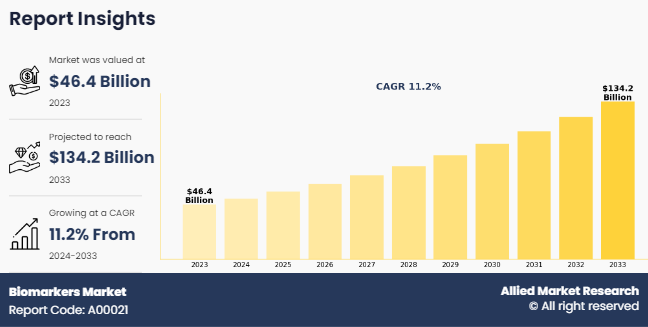
The global biomarkers market size was valued at $46.4 billion in 2023, and is projected to reach $134.2 billion by 2033, growing at a CAGR of 11.2% from 2024 to 2033. Rise in adoption of biomarkers for drug development and discovery and rise in prevalence of chronic diseases are expected to drive the growth of the biomarkers market.
Market Introduction and Definition
Biomarkers are measurable indicators that provide information about various biological processes in the body. They can be found in blood, urine, tissue samples, body fluids, and genetic material. They help detect diseases or underlying biological conditions, study their progression as well as analyze pharmacological effects of a drug or response to environmental exposure. They provide insights about the health status, response to treatment, or disease risk of an individual.
Biomarkers play a crucial role in early detection and diagnosis, enabling healthcare professionals to identify diseases at their onset when treatments are often most effective. In addition, biomarkers aid in monitoring disease progression, assessing the effectiveness of therapies, and predicting patient outcomes.
Key Takeaways
- By type, the sample preparation segment held the largest share in the biomarkers market in 2022. However, the efficacy biomarkers segment is expected to register the highest growth during the forecast period.
- By application, the drug discovery and development segment held the largest biomarkers market share in 2022. However, the disease diagnosis segment is expected to register the highest growth during the forecast period.
- By service, sample preparation segment held the largest share in the biomarkers market analysis in 2022. However, the assay development segment is expected to register the highest growth during the forecast period.
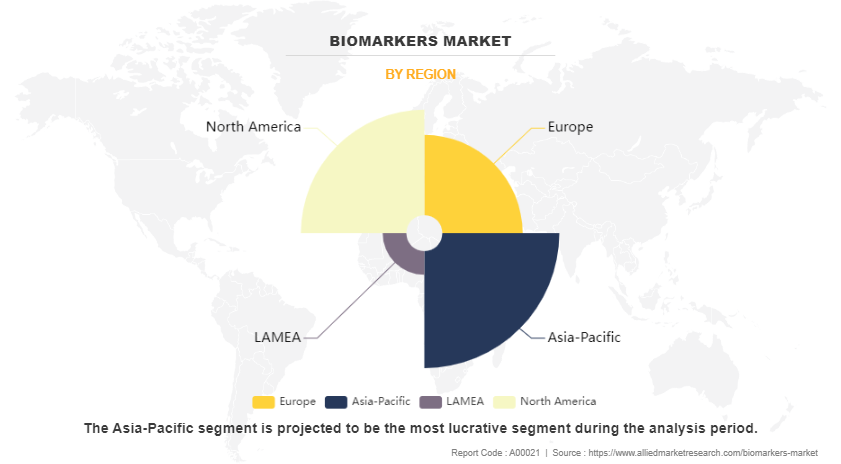
- Region-wise, North America held the largest market share in 2022. However, Asia-Pacific is expected to witness the highest CAGR during the forecast period.
Key Market Dynamics
Drivers
The increasing adoption of biomarkers in drug development drives the growth in the biomarkers market. Biomarkers, which are measurable indicators of biological processes or therapeutic responses, are widely used in the pharmaceutical industry for their ability to enhance efficiency and precision. They streamline drug development by providing critical insights into efficacy, safety, and mechanisms of action across preclinical and clinical stages. A 2020 report by the National Library of Medicine highlighted that biomarkers are extensively incorporated in the development of immunosuppressants, immunostimulants, antidiabetic drugs, antithrombotics, antineoplastic agents, and antivirals. Furthermore, biomarkers support personalized medicine by identifying patient populations most likely to benefit from specific treatments, thus improving outcomes and optimizing healthcare resources.
In addition, the rising prevalence of chronic diseases such as cancer, cardiovascular disorders, and neurological conditions is boosting market growth. A 2023 National Library of Medicine report noted that neurological disorders affect nearly 15% of the global population and are a leading cause of disability. As these conditions require early diagnosis and long-term management, demand for reliable diagnostic and prognostic tools is increasing. Biomarkers play a vital role in detecting disease progression, assessing treatment response, and enabling precise patient stratification, thereby supporting informed clinical decision-making. This is expected to drive the demand for biomarkers.
Restraints
High development cost of biomarkers hampers the growth of the biomarkers market. The development of biomarkers involves a complex, resource-intensive process that involves identification, validation, and commercialization. Researchers face considerable challenges in discovering reliable biomarkers due to the complexities of biological systems and the rigorous validation studies required to ensure accuracy and reproducibility. Regulatory requirements further intensify these challenges, as biomarker validation and approval typically demand extensive clinical trial to demonstrate clinical utility and safety. The substantial financial investment required throughout this process, from initial discovery through regulatory approval, is expected to constrain the biomarkers market growth, particularly for smaller organizations with limited resources.
Opportunities
Major industry players are advancing biomarker technology through collaborative initiatives that drive innovation in discovery platforms and establish standardized protocols for validation and regulatory approval. These coordinated efforts address critical challenges in biomarker development, including variability in sample collection, assay standardization, and data interpretation. Partnerships between pharmaceutical companies, research institutions, government agencies, and private organizations are accelerating technological progress across the sector. This collective approach to advancing biomarker technology is expected to provide lucrative opportunities for growth of the biomarkers market by reducing development timelines, improving reliability, and facilitating broader clinical adoption.
Pharmaceutical companies, research institutions, and biotechnology firms have recognized the potential of biomarkers in diagnostics, drug development, and personalized medicine. Strategic collaborations among these stakeholders enable the pooling of resources, expertise, and data sets, thereby accelerating the discovery and validation of novel biomarkers while reducing individual organizational risk and investment burdens. This is expected to be opportunistic for the biomarkers market.
Why Is Demand Increasing in the Biomarkers Market?
Demand in the biomarkers market is increasing due to the rising prevalence of chronic diseases such as cancer, cardiovascular disorders, and diabetes, which require early and accurate diagnosis. Growing emphasis on personalized medicine has boosted the need for targeted therapies supported by companion diagnostics. Advances in genomics, proteomics, and molecular diagnostics are enabling more precise biomarker discovery and application. Increased healthcare spending, expanding clinical research, and supportive regulatory frameworks are further driving growth. In addition, greater awareness of preventive healthcare and early disease detection, along with technological innovations like liquid biopsies and AI-based analysis, are accelerating adoption across clinical and research settings.
How Are Consumer Preferences Shaping Market Trends?
Consumer preferences are significantly shaping trends in the biomarkers market by driving demand for personalized, preventive, and minimally invasive healthcare solutions. Patients increasingly prefer early disease detection, prompting growth in predictive and prognostic biomarkers. The shift toward personalized medicine has accelerated adoption of companion diagnostics and targeted therapies, particularly in oncology. Demand for non-invasive testing methods, such as liquid biopsies, is expanding due to convenience and reduced risk. Consumers are also favoring faster, more accurate diagnostic results, encouraging innovation in molecular and genetic biomarkers. In addition, growing awareness of chronic diseases and wellness monitoring is fueling investment in advanced biomarker research and digital health integration.
Segments Overview
The biomarkers market growth is segmented on the basis of type, application, service, and region. By type, the market is divided into efficacy biomarkers, safety biomarkers, and validation biomarkers. By application, the market is classified into risk assessment, development of molecular diagnostic, disease diagnosis, drug discovery & development, drug formulation, forensic application, and others. By service, it is categorized into pharmaceutical & sample preparation, assay development, biomarker validation & testing, and other services. Region-wise, the biomarkers market is analyzed across North America, Europe, Asia-Pacific, and LAMEA.
By Type
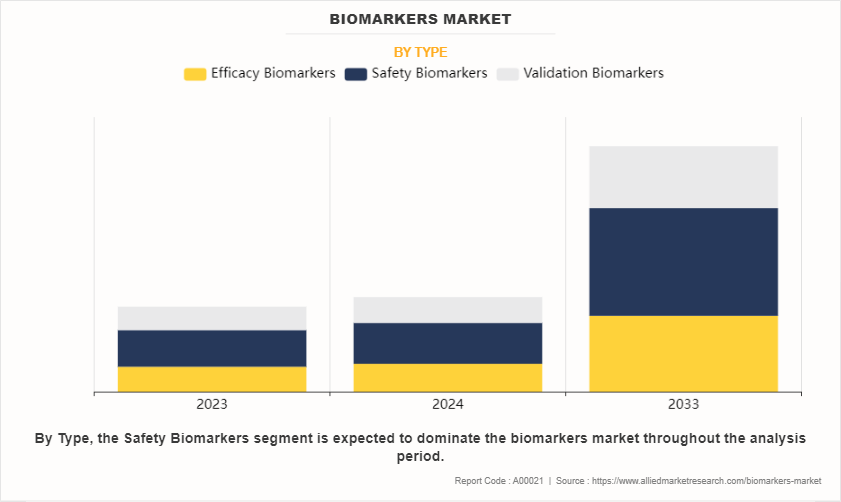
On the basis of type, the biomarkers market share is categorized into efficacy biomarkers, safety biomarkers, and validation biomarkers. The safety biomarkers segment dominated the global market in 2023 owing to high adoption of safety biomarkers for evaluation of safety of the drug candidate during the drug discovery and development process.
By Application
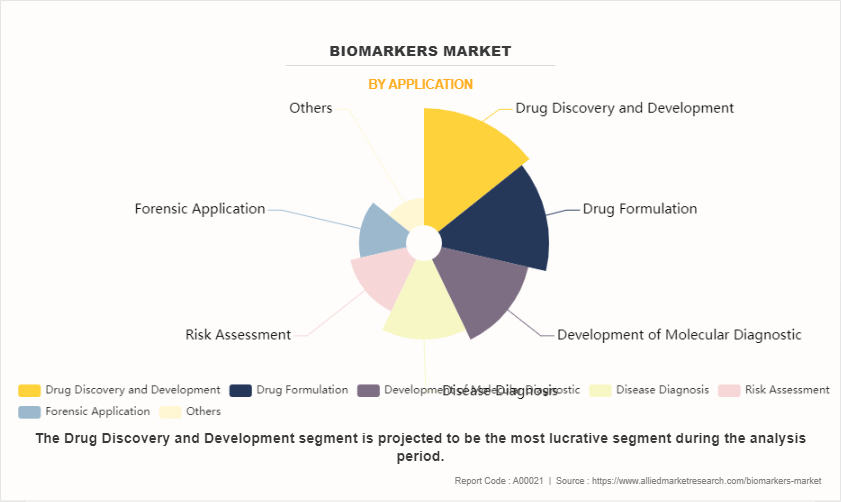
On the basis of application, the market is categorized into risk assessment, development of molecular diagnostic, disease diagnosis, drug discovery & development, drug formulation, forensic application, and others. The drug discovery and development segment dominated the global biomarkers market in 2023. This is attributed to the fact that the biomarkers are used for the safety and efficiency evaluation of the drug candidate during the clinical trials. However, the disease diagnosis segment is expected to register highest growth during the forecast period, owing to high use of the biomarkers in cancer and lung cancer biomarkers.
By Service
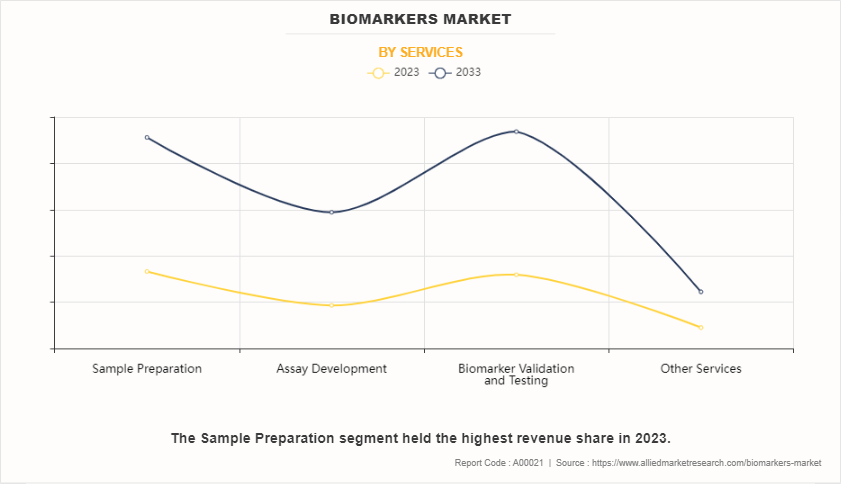
On the basis of service, the market is categorized into sample preparation, assay development, biomarker validation & biomarker testing, and other services. The sample preparation segment dominated the market in 2023. This is attributed to the fact that sample preparation encompasses a series of techniques aimed at extracting, isolating, and purifying biomolecules from complex biological matrices such as blood, urine, or tissue samples. These preparatory steps are crucial for enhancing the sensitivity, specificity, and reproducibility of biomarker assays, improving diagnostic accuracy and clinical utility. However, the assay development segment is expected to register the highest CAGR as assay development plays a pivotal role in the biomarker discovery process, serving as the foundation for accurately measuring and quantifying specific biomolecules indicative of various biological processes or disease states.
Regional/Country Market Outlook
The biomarkers market is analyzed across North America, Europe, Asia-Pacific, and LAMEA. North America dominated the market share in terms of revenue in 2023. The growth in this region is mainly attributed to the strong presence of key players and higher adoption of biomarkers for new drug development processes.
Asia-Pacific is expected to grow at the highest rate during the forecast period. This is attributed to the rise in prevalence of chronic diseases and high adoption of biomarkers for disease diagnosis such as in lung cancer biomarkers. Furthermore, the biomarkers market in Asia-Pacific is cost effective as compared to North America and some parts of Europe.
Competitive Analysis
Competitive analysis and profiles of the major players in the biomarkers market, such as GE Healthcare, Abbott Laboratories, Inc., Bio-Rad Laboratories, Epistem Ltd., Eisai Co. Ltd., Roche Diagnostics Limited, Thermo Fisher Scientific Inc., Agilent Technologies Inc., Aushon Biosystem, and Siemens AG are provided in the report. Major players have adopted product launch, strategic alliance, partnership, new product development, and collaboration as key developmental strategies to improve their product portfolio and gain a strong foothold in the biomarkers market.
Recent Developments
- In July 202, Quanterix completed its acquisition of Akoya Biosciences, thereby strengthening ultra-sensitive biomarker detection across oncology, immunology, and neurology.
- Major firms such as Roche, Eurofins, Merck, and Thermo Fisher are rolling out new assays, automation partnerships, and large-scale proteomics collaborations to accelerate discovery and clinical application, which are expanding precision diagnostics and fueling market growth.
- In February 2024, Abbott Laboratories and Fujirebio announced a partnership to develop a research use only (RUO) neurofilament-light chain (Nf-L) neurology biomarker assay for use on Abbott's Alinity i.
- In January 2024, Merck KGaA announced that it has entered into a collaboration with Quibim, the global company transforming imaging data into actionable predictions of cancer progression and treatment response. The two companies explore how to harness the potential of biomarkers and radiomics to predict a cancer patient's response to immunotherapy and predict cancer patient outcomes.
What Technological Innovations Are Creating New Growth Opportunities?
Technological innovations are creating significant growth opportunities in the biomarkers market through advances in genomics, proteomics, and next-generation sequencing (NGS). High-throughput screening and multi-omics technologies enable faster and more precise biomarker discovery. Artificial intelligence and machine learning are improving data analysis, enhancing predictive accuracy and accelerating drug development. Liquid biopsy technologies are expanding non-invasive diagnostic options, particularly in oncology. Digital health tools and wearable devices support real-time biomarker monitoring. In addition, advancements in bioinformatics, microfluidics, and point-of-care testing platforms are increasing accessibility, reducing costs, and enabling personalized treatment approaches, thereby driving innovation and expanding clinical applications.
How Is Artificial Intelligence Transforming The Biomarkers Market?
Artificial Intelligence (AI) is significantly transforming the growth of the biomarkers market by accelerating discovery, improving diagnostic accuracy, and enabling precision medicine. AI-powered algorithms can analyze vast volumes of genomic, proteomic, and clinical data to identify novel biomarker patterns that traditional methods may overlook. This capability reduces research timelines, lowers development costs, and increases the success rate of drug discovery programs.
In clinical applications, AI enhances the interpretation of complex datasets from imaging, molecular diagnostics, and liquid biopsies. Machine learning models help detect subtle disease markers, thus enabling early diagnosis of conditions such as cancer, neurological disorders, and cardiovascular diseases. AI also improves patient stratification in clinical trials by identifying individuals most likely to respond to specific therapies, which increases the trial efficiency and treatment effectiveness.
In addition, AI-driven bioinformatics platforms integrate multi-omics data to generate more comprehensive insights into disease mechanisms. Real-time analytics and predictive modeling further support personalized treatment planning and remote patient monitoring. By streamlining workflows, enhancing data accuracy, and enabling faster innovation, AI is driving technological advancement and expanding commercial opportunities in the global biomarkers market.
How Do Government Policies and Regulations Impact Regional Biomarkers Market Growth?
Government policies and regulations influence the biomarkers market growth in various regions by shaping research funding, approval timelines, and commercialization pathways. Supportive policies, such as grants for precision medicine and incentives for biotechnology innovation, accelerate biomarker discovery and clinical adoption. Clear regulatory frameworks for diagnostic approvals and companion diagnostics enhance investor confidence and market entry. Conversely, stringent approval processes and complex compliance requirements can delay product launches and increase development costs. Reimbursement policies also play a critical role, as favorable coverage encourages clinical use. Overall, proactive regulatory support and healthcare investment drive faster regional biomarkers market expansion and innovation in the biomarkers sector.
What Role Do Digital Technologies Play in Improving Products and Services?
Digital technologies play a crucial role in improving products and services by enhancing efficiency, accuracy, and customer experience. Advanced data analytics enables organizations to collect and interpret large volumes of real-time data, leading to better decision-making and continuous product optimization. Cloud computing supports scalable infrastructure, allowing businesses to deliver faster updates, seamless integration, and remote accessibility.
The Internet of Things (IoT) enhances connectivity by linking devices and systems, enabling real-time monitoring, predictive maintenance, and performance tracking.
Digital platforms also streamline service delivery through automation, chatbots, and self-service portals, reducing response times and operational costs. In industries such as healthcare and manufacturing, digital twins and simulation technologies help test and refine products before market launch, minimizing risks and accelerating innovation.
In addition, cybersecurity solutions protect sensitive data, strengthening customer trust and regulatory compliance. By integrating digital tools into core operations, companies can enhance product quality, improve service reliability, reduce costs, and respond quickly to evolving biomarkers market demands, ultimately driving long-term growth and competitiveness.
Key Benefits for Stakeholders
- This report provides a quantitative analysis of the market segments, current trends, estimations, and dynamics of the biomarkers market analysis from 2023 to 2033 to identify the prevailing biomarkers market opportunity.
- The biomarkers market research is offered along with information related to key drivers, restraints, and opportunities.
- Porter's five forces analysis highlights the potency of buyers and suppliers to enable stakeholders make profit-oriented business decisions and strengthen their supplier-buyer network.
- In-depth analysis of the biomarkers market segmentation assists to determine the prevailing market opportunities.
- Major countries in each region are mapped according to their revenue contribution to the global biomarkers market.
- Market player positioning facilitates benchmarking and provides a clear understanding of the present position of the market players.
- The report includes the analysis of the regional as well as global biomarkers industry trends, key players, market segments, application areas, and biomarkers market growth strategies.
Biomarkers Market Report Highlights
| Aspects | Details |
 Market Size By 2033 | USD 134.2 billion |
 Growth Rate | CAGR of 11.2% |
 Forecast period | 2023 - 2033 |
 Report Pages | 347 |
 By Type |
|
 By Application |
|
 By Services |
|
 By Region |
|
 Key Market Players | Thermo Fisher Scientific Inc., Siemens AG, Merck KGaA, Agilent Technologies Inc., F. Hoffmann-La Roche AG, Abbott Laboratories, Bio-Rad Laboratories, Inc. , GE Healthcare, Qiagen N.V, Revvity, Inc. |
Analyst Review
The biomarkers market has witnessed remarkable growth and transformative potential in recent years, propelled by advancements in personalized medicine, diagnostic technologies, and a deeper understanding of molecular biology. Biomarkers play a pivotal role in revolutionizing patient care by offering precise and early indicators of disease onset, progression, and treatment response. The integration of innovative technologies such as genomics, proteomics, and metabolomics has expanded the scope and utility of biomarkers across various therapeutic areas, ranging from oncology to neurology.
Furthermore, the emergence of non-invasive biomarkers and point-of-care testing solutions has revolutionized patient care by enabling early detection, monitoring disease progression, and guiding therapeutic decisions. However, challenges persist, including the validation and standardization of biomarker assays, regulatory complexities, and reimbursement issues. Despite these challenges, the biomarkers market is expected to register significant growth during the forecast period owing to high adoption of biomarkers for disease diagnosis and for drug development process.
High development cost of biomarkers stands as a significant restraint for the growth of the biomarkers market.
Yes, competitive landscape included in the report
The primary trends driving the biomarkers market include heightened adoption of biomarkers in liquid biopsies, significant advancements in proteomics, and the emergence of digital biomarkers as key players in healthcare monitoring and diagnostics.
The biomarkers market was valued at $46,401.30 million in 2023 and is estimated to reach $134,181.30 million by 2033, exhibiting a CAGR of 11.2% from 2024 to 2033.
The drug discovery and development segment dominated the global market in 2023.
North America is the largest regional market
Abbott Laboratories, Inc., Bio-Rad Laboratories, Ge Healthcare, Roche Diagnostics Limited, Siemens AG, and Thermo Fisher Scientific Inc. are key companies to hold major share in the biomarkers market
High adoption of biomarkers for drug development procedures stands as a significant driver that propels biomarkers market growth.
Loading Table Of Content...
Loading Research Methodology...