
Cryptocurrency Market Research, 2033
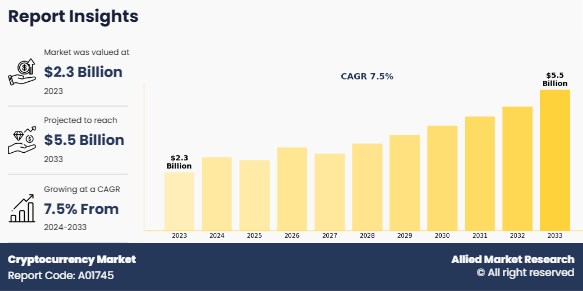
The global cryptocurrency market was valued at $2.3 billion in 2023, and is projected to reach $5.5 billion by 2033, growing at a CAGR of 7.5% from 2024 to 2033. Increase in participation of institutional investors and rise developments in blockchain technology are expected to drive the growth of the market. Additionally, the growing acceptance of cryptocurrencies as a legitimate payment method by major businesses is boosting market adoption. Moreover, advancements in regulatory frameworks are enhancing investor confidence, further fueling growth.
Market Introduction and Definition
Cryptocurrency is built on blockchain technology. It is a type of virtual currency that uses cryptography for security. It gained popularity with the introduction of Bitcoin. Transactions in bitcoin are grouped into blocks, validated through consensus mechanisms and then added to the chain. This ensures transparency and resistance to tampering.
Traditional financial systems rely on centralized institutions to verify and process transactions. However, there is no central authority in cryptocurrency. Therefore, users maintain control over their funds through private cryptographic keys. Additionally, cryptocurrencies can facilitate cross-border transactions with lower fees and faster settlement times compared to traditional banking systems.
The cryptocurrency market includes a digital ecosystem where various decentralized digital currencies, often utilizing blockchain technology, are traded and exchanged. These digital assets serve as mediums of exchange, units of account, and stores of value, independent of traditional financial institutions. Participants in the market include individual investors, institutions, miners, and developers, engaging in activities such as buying, selling, and holding cryptocurrencies. Market dynamics are influenced by factors such as regulatory developments, technological advancements, market sentiment, and macroeconomic conditions, shaping the volatility and growth of this evolving financial landscape.
However, cryptocurrencies are also known for their price volatility. Market prices can fluctuate within short periods. This volatility attracts traders and investors seeking high returns. Also, cryptocurrency exchanges and digital wallets can be vulnerable to hacking and mismanagement. Regulatory uncertainty further complicates the landscape. Despite these challenges, major companies accept crypto payments. There is a focus on blockchain technology for applications in supply chain management, healthcare, real estate, and voting systems.
Key Market Dynamics
Increase in need for operational efficiency and transparency in financial payment systems, rise in demand for remittances in developing countries, increase in data security, and increase in cryptocurrency market capitalization of cryptocurrency are the major factors that drive the growth of themarket. Moreover, high implementation cost and lack of awareness of cryptocurrency among the people in developing nations hamper the cryptocurrency market growth. Furthermore, increase in demand for cryptocurrency among banks, and financial institutions and untapped potential on emerging economies are expected to provide lucrative opportunity for the market expansion during the cryptocurrency market forecast period.
The cryptocurrency market includes a digital ecosystem where various decentralized digital currencies, often utilizing blockchain technology, are traded and exchanged. These digital assets serve as mediums of exchange, units of account, and stores of value, independent of traditional financial institutions. Participants in the market include individual investors, institutions, miners, and developers, engaging in activities such as buying, selling, and holding cryptocurrencies. Market dynamics are influenced by factors such as regulatory developments, technological advancements, market sentiment, and macroeconomic conditions, shaping the volatility and growth of this evolving financial landscape.
Increase in need for operational efficiency and transparency in financial payment systems, rise in demand for remittances in developing countries, increase in data security, and increase in cryptocurrency market capitalization of cryptocurrency are the major factors that drive the growth of themarket. Moreover, high implementation cost and lack of awareness of cryptocurrency among the people in developing nations hamper the cryptocurrency market growth. Furthermore, increase in demand for cryptocurrency among banks, and financial institutions and untapped potential on emerging economies are expected to provide lucrative opportunity for the market expansion during the cryptocurrency market forecast period.
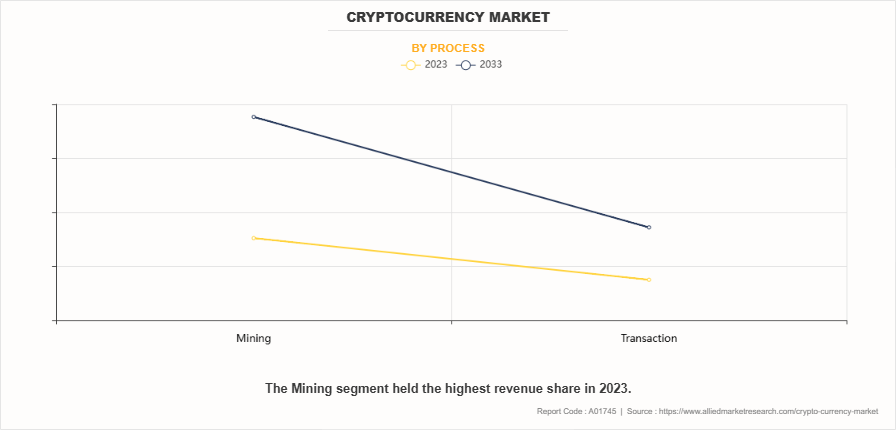
On the basis of process, the mining segment is dominated the cryptocurrency market size in 2023, owing to rise in need for upgrading the performance of the software and to enhance the efficiency of financial payment tools. However, the software segment is expected to grow at the highest growth during the forecast period, as it facilitates managing the massive volume of data being generated for meaningful insights and better-informed decisions.

By region, the market was dominated by North America in 2023 and is expected to retain its position during the forecast period. Owing to increase in number of Bitcoin exchange across U.S., which bring a certain healthy competition and maturity to the cryptocurrency market. Banks are hiring blockchain experts as the government pushes the use of the technology behind bitcoin to increase transparency and combat fraud in its financial sector. These factors drive growth of the cryptocurrency market in North America.
The report focuses on the growth prospects, restraints, and trends of the global cryptocurrency market analysis. The study provides Porters five forces analysis to understand the impact of various factors such as bargaining power of suppliers, competitive intensity of competitors, threat of new entrants, threat of substitutes, and bargaining power of buyers on the market.
Key Findings of the Study
- By process, the mining segment accounted for the highest market portion in 2023.
- By end user, the individuals/personal segment accounted for the highest cryptocurrency market portion in 2023.
- By end user industry, the trading segment accounted for the highest cryptocurrency market portion in 2023.
- By type, the Bitcoin (BTC) segment accounted for the highest cryptocurrency market share in 2023.
- By region, North America generated the highest revenue in 2023.
Key Market Segments
On the basis of process, the mining segment is dominated the cryptocurrency market size in 2023, owing to rise in need for upgrading the performance of the software and to enhance the efficiency of financial payment tools. However, the software segment is expected to grow at the highest growth during the forecast period, as it facilitates managing the massive volume of data being generated for meaningful insights and better-informed decisions. For instance, a startup called Core Scientific, based in Bellevue, raised $23 million to expand its cryptocurrency mining operations, owing to rise in demand for bitcoin from institutional investors considered as store of value for a long term. Mining companies such as Core Scientific are in a position to make money and help to repatriate crypto production. Furthermore, Bitcoin, is equivalent to a piece of gold nowadays worth around $20,000. Mining a single Bitcoin block brings a reward of 6.25 million or about $125,000. All these factors make the U.S. as the second-biggest mining destination across the globe, accounting for around 17% of all the global bitcoin miners.
By region, the market was dominated by North America in 2023 and is expected to retain its position during the forecast period. Owing to increase in number of Bitcoin exchange across U.S., which bring a certain healthy competition and maturity to the cryptocurrency market. Banks are hiring blockchain experts as the government pushes the use of the technology behind bitcoin to increase transparency and combat fraud in its financial sector. These factors drive growth of the cryptocurrency market in North America. For instance, PayPal Holdings, Inc. announced launch of a new service on October 21, 2020, which enable customers to buy, hold, and sell cryptocurrency directly from their PayPal account and significantly increase utility of cryptocurrencies by making it available as a funding source for purchases at 26 million merchants store worldwide.
U.S. has become the second biggest destination of Bitcoin mining, accounting for 17% of the world’s bitcoin miners in April, 2021. For instance, Quontic Bank launched a Bitcoin Rewards checking account on 19, April, 2021, which pays account holders 1.5% in Bitcoin on purchases made with their account’s debit card.
The cryptocurrency market in Canada is expected to grow at the fastest growth rate in upcoming years, owing to its cold climate, electric supply, and light regulation. Furthermore, on June 26, 2021, the Canadian Security Association’s (CSA) took an initiative toward financial technology (Fintech) businesses, which is seeking to offer innovative products such as by carefully vetting business models in live-testing environments.
Competition Analysis:
Competitive analysis and profiles of the major players in the cryptocurrency market are Binance, Coinbase, Inc., Tether Operations Limited, Stiftung Ethereum, Grayscale Investments, LLC, Bitcoin Foundation, Ripple Labs, Inc., MicroStrategy Incorporated, Bitmain Technologies Holding Company, and Payward, Inc. These players have adopted various strategies to increase their market penetration and strengthen their position in the cryptocurrency market.
Recent Developments in the cryptocurrency Industry:
- In May 2024, MoonPay partnered with PayPal to introduce a crypto purchasing option for cryptocurrency app users in the U.S. This service enables users to use PayPal for transactions via wallet transfers, bank transfers, and debit cards. The integration promises to enhance the accessibility and convenience of buying and trading cryptocurrencies by bridging the gap between traditional financial services and the crypto market.
- In September 11, 2023, PayPal unveiled on- and off-ramps for web3 payments, providing users in the U.S. with a seamless method to convert their cryptocurrencies, such as Bitcoin (BTC) and Ethereum (ETH), into U.S. Dollars directly within their PayPal wallets.
Key Market Segments
The cryptocurrency market is segmented on the basis of process, type, end user, end user industry, and region. By end user, it is fragmented into individuals/personal, organizations. By process, it is bifurcated into mining and transaction. By type, it is segmented into bitcoin (BTC), Ethereum (ETH), tether (USDT), binance coin (BNB), Cardano (ADA), ripple (XRP), and others. By end user industry, it is classified into individuals and organizations. By region, the market is analyzed across North America, Europe, Asia-Pacific, and LAMEA.
What Are the Strategies Adopted by the Key Players in the Market?
One of the most common strategies adopted by market players is technological innovation and product development. Companies continuously improve blockchain infrastructure, security protocols, and transaction speeds to enhance platform performance. For instance, cryptocurrency exchanges are introducing advanced trading features, staking services, and decentralized finance (DeFi) integrations to attract more users and institutional investors. Another major strategy is strategic partnerships and collaborations. Cryptocurrency companies collaborate with fintech firms, payment providers, and financial institutions to expand service offerings. Partnerships allow companies to integrate crypto payment gateways, cross-border transaction services, and digital asset custody solutions. These collaborations improve the adoption of cryptocurrencies in sectors such as e-commerce, banking, and retail.
Geographical expansion is also a significant growth strategy. Major cryptocurrency platforms are entering emerging markets in Asia-Pacific, Latin America, and Africa where digital asset adoption is increasing. Expansion efforts typically involve establishing regional offices, forming partnerships with local financial institutions, and ensuring compliance with regional regulatory frameworks. Another key strategy involves investment in infrastructure and mining technology. Hardware manufacturers and mining companies are developing more efficient mining equipment to improve profitability and reduce energy consumption. According to Allied Market Research, several companies in the mining ecosystem are focusing on new hardware launches, collaborations, and joint ventures to strengthen their technological capabilities and expand their customer base.
How Intense Is Market Competition and What Defines Competitive Advantage?
Market competition is considered moderately concentrated but highly dynamic. Industry reports indicate that the top cryptocurrency platforms account for a large portion of global trading activity and transaction volumes. However, the continuous emergence of new cryptocurrencies, decentralized applications, and blockchain networks intensifies the competitive environment. Several factors define competitive advantage in the cryptocurrency market. The first and most important factor is technological capability. Companies that develop faster blockchain networks, scalable infrastructure, and secure digital wallets gain a strong competitive edge. Platforms that support smart contracts and decentralized finance applications attract developers and users, strengthening ecosystem growth. Another key factor is security and trust. Due to frequent cyber threats and exchange hacks in the industry, companies that implement strong security protocols, multi-factor authentication, and institutional-grade custody solutions gain higher credibility among investors and traders.
Top impacting factors
Rise in need for transparency in the payment system
The cryptocurrency market is expected to witness promising growth in the coming years, owing to improved data transparency and independency across payments in banks, financial services, insurance, and various other business sectors. The use of crypto currency across banking industries provides various benefits such as sending and receiving payment transparently and storing customers detail information securely for next purpose. For instance, in October 2024, Coinbase filed two Freedom of Information Act (FOIA) requests, demanding transparency from the U.S. regulators regarding their crackdown on the cryptocurrency industry, particularly concerning deposit limitations imposed on banks. The exchange seeks clarity on the Federal Deposit Insurance Corporationas (FDIC) stance on digital assets and its handling of past information requests, signalling a growing tension between the burgeoning crypto industry and regulatory bodies. Furthermore, innovative blockchain distributed technology protocols are expected to replace the need for certain organizational solutions and allow diverse players to share payment transparently across Coinbase. Such systems bring transparency to supply chains, helping in elimination of environmental crimes and others. This boosts the adoption of cryptocurrency in the future.
Untapped Potential on emerging economies
Emerging economies present significant untapped potential for the cryptocurrency market. With rapid digitalization and limited access to traditional banking systems, these regions provide fertile ground for crypto adoption. Many consumers in emerging markets lack access to financial services, which is creating a demand for decentralized solutions such as cryptocurrencies. In addition, blockchain technology offers a way to bypass inefficient banking infrastructures, enabling secure, low-cost transactions across borders. Moreover, governments in some emerging economies have begun to explore crypto-friendly regulations, recognizing the potential to boost financial inclusion and stimulate economic growth. These markets often face currency instability and inflation, making cryptocurrencies an attractive alternative for wealth preservation. Furthermore, growth of mobile internet usage accelerates crypto adoption, as smartphones serve as gateways to digital wallets and exchanges. Investors and blockchain companies are prioritising developing regions such as Asia-Pacific to capture early market share. In addition, by tailoring solutions to local needs, such as microtransactions and remittances, cryptocurrency businesses can drive adoption and build trust within these economies. Moreover, there is considerable potential for growth, both in terms of increasing consumer adoption and in developing smart contracts financial systems that integrate with local economies.
Key benefits for stakeholders
- This report provides a quantitative analysis of the market segments, cryptocurrency market trends, estimations, and dynamics of the market forecast from 2023 to 2033 to identify the prevailing market opportunities.
- Market research is offered along with information related to key drivers, restraints, and opportunities of cryptocurrency market outlook.
- Porter's five forces analysis highlights the potency of buyers and suppliers to enable stakeholders to make profit-oriented business decisions and strengthen their supplier-buyer network.
- In-depth analysis of the market segmentation assists in determining the prevailing cryptocurrency market opportunity.
- Major countries in each region are mapped according to their revenue contribution to the global market.
- Market player positioning facilitates benchmarking and provides a clear understanding of the present position of the market players.
- The report includes an analysis of the regional as well as global market trends, key players, market segments, application areas, and market growth strategies.
Cryptocurrency Market Report Highlights
| Aspects | Details |
 Forecast period | 2023 - 2033 |
 Report Pages | 200 |
 By Process |
|
 By End Use Industry |
|
 By End User |
|
 By Type |
|
 By Region |
|
 Key Market Players | Stiftung Ethereum, Binance, Ripple Labs, Inc., Coinbase, Inc., MicroStrategy Incorporated, Grayscale Investments, LLC, Payward, Inc., Bitcoin Foundation, Bitmain Technologies Holding Company, Tether Operations Limited |
The Cryptocurrency Market is estimated to grow at a CAGR of 7.5% from 2024 to 2033.
The Cryptocurrency Market is projected to reach $5.5 billion by 2033.
The Cryptocurrency Market is expected to witness notable growth due to the increased need for operational efficiency and transparency in financial payment systems, the rise in demand for remittances in developing countries, the increase in data security, and the increase in cryptocurrency's market capitalization.
The report profiles key players including Binance, Coinbase, Inc., Tether Operations Limited, Stiftung Ethereum, Grayscale Investments, LLC, Bitcoin Foundation, Ripple Labs, Inc., MicroStrategy Incorporated, Bitmain Technologies Holding Company, and Payward, Inc.
The key growth strategies of Cryptocurrency Market players include expanding their product portfolios, mergers and acquisitions, agreements, geographical expansion, and collaborations.
Loading Table Of Content...
Loading Research Methodology...